At the Metropolitan Museum of Art in New York, I had the opportunity to see Vincent van Gogh’s work up close. I was already familiar with his story and his letters. Even so, standing before those paintings gave another dimension to what I had read. Two of the works I saw were from the period when he was staying in a psychiatric institution.
This is one of the episodes in his life that fascinates me most. During approximately a year in the hospital, Van Gogh produced more than a hundred paintings. Some of the works through which we know him today were created while he was experiencing a period of profound vulnerability.
I thought about how a crisis can affect the way we see our own abilities. A business struggles, a relationship ends, a project stops working. Gradually, doubt about that situation begins to reach into other parts of our lives. We question our work, our choices, and even whether we still have something to contribute.
Vincent’s story interests me because it allows us to look more closely at that experience. To do so, we also need to understand what happened between the paintings.
On May 8, 1889, he voluntarily entered Saint-Paul-de-Mausole in Saint-Rémy-de-Provence, in southern France. He had endured difficult months in Arles, marked by episodes of illness and hospitalization. His decision to enter the institution was part of an effort to find circumstances in which he could live with what he was facing.
A few days earlier, on May 3, he wrote to his brother Theo. He was packing his trunk and considering what he might be able to do in the hospital. He contemplated returning to pen drawing, a less expensive activity that he could pursue in different circumstances. He also expressed doubts about his importance as a painter. Even so, he hoped to work again.
That letter holds my attention because Vincent did not yet know the course his life’s work would take. He needed to think about expenses, materials, and practical ways to occupy his time. His future work offered no guarantee. There was the knowledge he already had, the difficulties of that moment, and a hope that he could still do something with what he knew.
At the hospital, he was given an additional room in which to work. At first, his subjects came from the institution’s grounds. The garden became part of his painting.
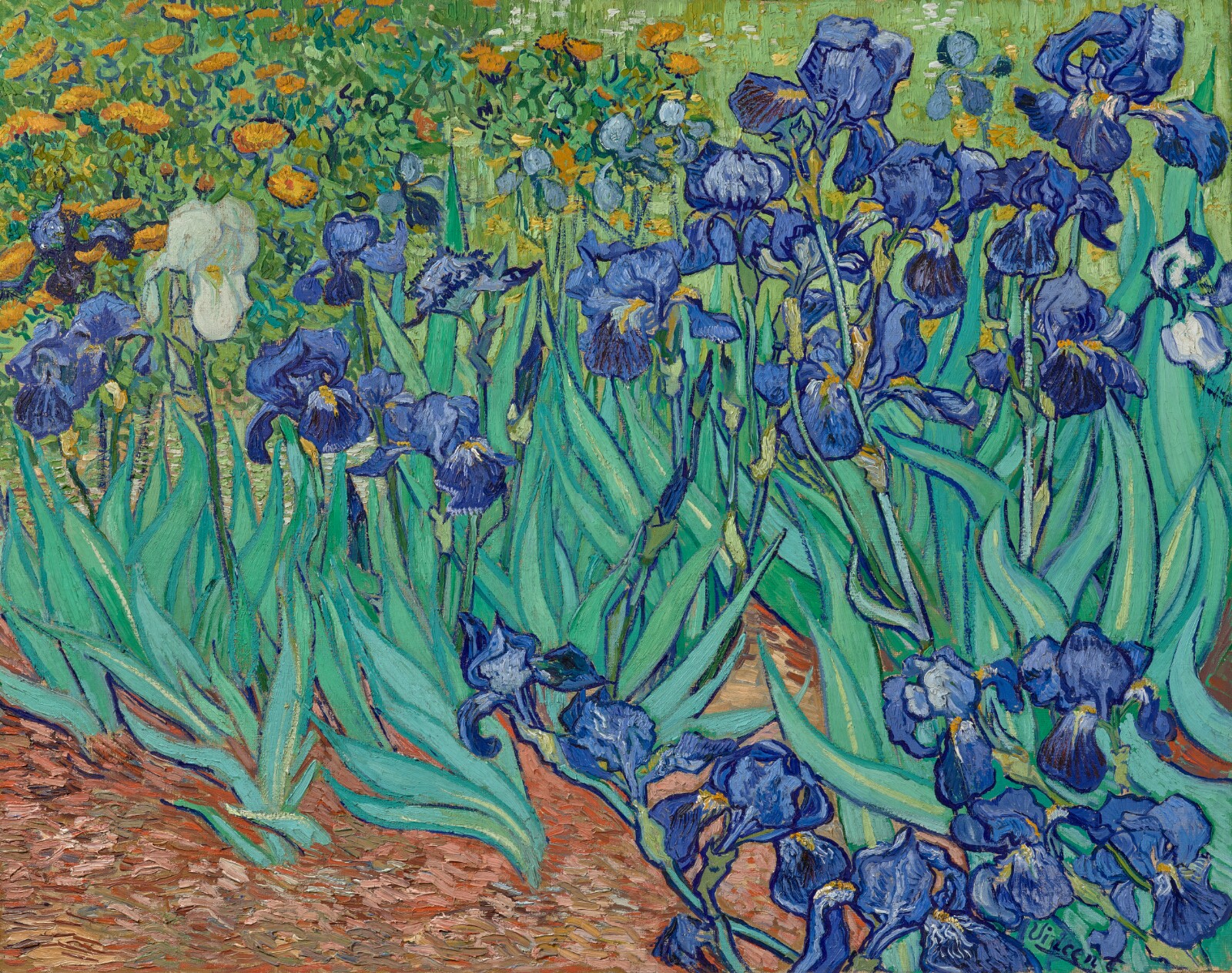
On May 9, he wrote to Theo and his sister-in-law Jo, telling them that he had two canvases underway: violet irises and a lilac bush. In the same letter, he said he believed he had done the right thing by going there. Living alongside other patients was reducing his fear of the illness.
It was during his first week at the hospital that he began Irises, now in the collection of the Getty Museum in Los Angeles. This painting is different from the composition of flowers in a vase held by the Met.
I like to consider that beginning in terms of what was actually available to him. There was a garden, materials, a place to work, and a painter who remained interested in what he saw. The circumstances of his life had changed profoundly. At certain times, his eye and his knowledge of painting could still find expression.
The letters also reveal the moments when that was no longer possible.
In August, Vincent told Theo that even writing had become difficult. The episodes of illness had returned, and he no longer had access to the room where he painted. He asked his brother to speak to the doctor because he wanted to work again and found inactivity distressing.
Around September 2, he wrote that he had begun working a little again the previous day. He had started a painting of a field he could see from his window. He did not know whether the improvement would last. He recognized that he needed to be patient.
That small amount of work seems to me as important as the number of paintings he produced that year. It brings us closer to the experience of someone returning to an activity without knowing how much he will be able to do. The work we can now bring together in an exhibition emerged amid interruptions, attempts, and periods of greater stability.
Theo followed all of this. He received news about Vincent’s health, discussed paintings, arranged supplies, and considered alternatives for his brother’s life. He also expressed concern about the intensity of his work.
At the same time, he recognized the value of what Vincent was producing. In September 1889, he wrote about Irises being shown at the Salon des Indépendants in Paris, describing it as “a fine study full of air and life.” Here was someone who knew his difficulties and continued to pay close attention to his achievements.
As I read their correspondence, I return to the question that my museum visit brought to mind: what happens when a difficulty takes up our entire field of vision?
Someone can encounter a professional setback and begin to interpret an entire career through it. Years of experience, relationships built, and knowledge acquired can start to seem irrelevant in the face of something that is not working now.
The problem needs to be acknowledged. There may be losses, limitations, and difficult decisions ahead. But understanding a situation also requires identifying what remains available. If we examine only what is missing, our understanding is incomplete at precisely the moment when we need to make a decision.
I think of a businesswoman who no longer finds meaning in the operation she has built. Perhaps she is exhausted by the routine, worried about results, or realizing that she wants a different way of working. When she says that her experience is no longer useful, she brings several different questions together in a single conclusion.
The business may need to change. Some responsibilities may have become unsustainable. Her interests may have shifted. Even so, her ability to negotiate, understand a client, coordinate people, or develop a project deserves to be examined separately. Perhaps those skills could find another application. Perhaps she needs time to discover what that might be.
It is in this kind of inquiry that I see a connection with the work I do through Private Advisory.
When someone brings me a situation, I try to understand both the difficulty and the context in which it exists. What happened? Which consequences have already become concrete? What resources remain? What does this person want to preserve, and what needs to be reconsidered?
In the C.L.A.R.O. Method, we begin with the current situation and the desired destination before developing alternatives, a route, and the organization needed to proceed. That sequence matters because we can devote enormous effort to restoring a situation without examining whether we still want to return to it.
During a crisis, the destination may also need to be reconsidered. The priority may be to regain the capacity to make decisions, reorganize commitments, or find a different way to use our experience. A next step can be small and still represent an important choice.
Van Gogh’s story does not make creating an obligation during suffering. There were times when he could not work and needed care. Nor does a person’s worth depend on what they can deliver. That understanding needs to accompany our admiration for his paintings.
What interests me is the possibility of recognizing that vulnerability and ability can coexist, although expressing that ability depends on conditions that are not always present. Understanding those conditions requires more care than simply asking someone to keep going.
It also requires people who can see beyond the immediate difficulty. In the letters, Theo takes part in that recognition: he discusses the illness, but also colors, materials, exhibitions, and possibilities. Vincent remained his brother and an artist whose work deserved a response.
When I think of the paintings I saw at the Met, it is that human dimension that stays with me. We know the value those paintings came to hold. While making them, Vincent had to live with uncertainty about his health, his work, and his future.
Perhaps that is why his story fascinates me so much. It makes me consider more carefully what a difficult period allows us to conclude about a life. Standing before those paintings, I was left wondering about everything that may still exist within a person when they themselves find it difficult to recognize.
Historical sources and editorial note
The letter of September 2 is paraphrased. The quotation from Theo’s letter of September 5 follows the English text in the scholarly edition Vincent van Gogh: The Letters, published by the Van Gogh Museum and Huygens ING.
- Letter 768: Vincent to Theo, May 3, 1889
- Letter 770: Theo to Vincent, May 8, 1889, notes on admission
- Letter 772: Vincent to Theo and Jo, May 9, 1889
- Letter 797: Vincent to Theo, August 22, 1889
- Letter 798: Vincent to Theo, around September 2, 1889
- Letter 799: Theo to Vincent, September 5, 1889
- Letter 802: Theo to Vincent, September 18, 1889
- Getty Museum: Irises, 1889
- The Met: Irises, 1890, a different composition
- The Met: Vincent van Gogh (1853–1890)
- Van Gogh Museum: Hospitalization
Institutional estimates differ: the Getty mentions nearly 130 paintings; the Met and Van Gogh Museum, about 150. The article therefore uses “more than a hundred.”