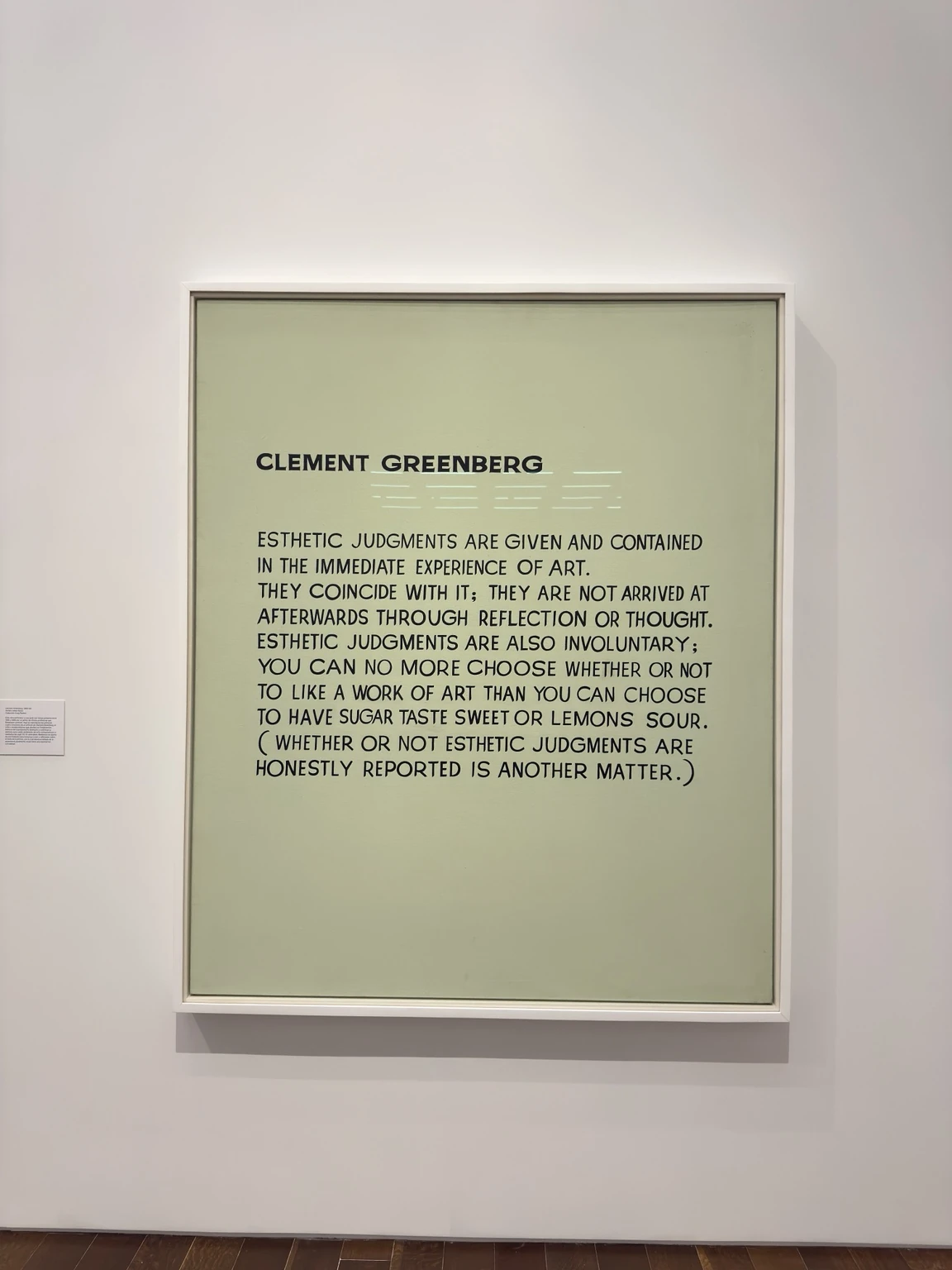
At the Pérez Art Museum Miami, a work by John Baldessari featured a text by Clement Greenberg about how we judge art. He said that this judgment happens within the experience itself, involuntarily. The comparison was simple: we do not choose to find sugar sweet or lemons sour. In the same way, liking what we see would not be a matter of choice.
“Esthetic judgments are given and contained in the immediate experience of art. They coincide with it; they are not arrived at afterwards through reflection or thought. Esthetic judgments are also involuntary; you can no more choose whether or not to like a work of art than you can choose to have sugar taste sweet or lemons sour. (Whether or not esthetic judgments are honestly reported is another matter.)”
Clement Greenberg, text reproduced in the work.
I kept thinking about that. When I look at something, I usually have a reaction before I can explain it. I like it, I don't like it, I find it strange, I want to look more closely. That first response feels very much my own. And it is. But where does it come from?
When I look again after learning something, I bring a reference I did not have before. To me, this makes it possible to distinguish the initial reaction from a new experience with the same work. The first response was real. The next one may be different because I now notice something I had not noticed before.
The work itself stays the same. What changes is what I can see in it.
This happens with a book we read at different points in our lives. A passage that once seemed unimportant can, after a particular experience, feel as though it was written just for us. The words were already there. Our experience is what brought us closer to them.
I may not choose to like a work at that moment. But I can choose to learn more about it. I can read, ask questions, look again. I do not have to end up liking it. Learning more can also confirm an opinion, now with more to support it.
Greenberg also makes a parenthetical observation: reporting a judgment honestly is another matter. I can recognize the importance of a work without liking it. If I say I liked it simply to agree with someone I respect, my words no longer reflect what I felt. That observation makes me consider how I might publicly support an opinion I have not yet examined for myself.
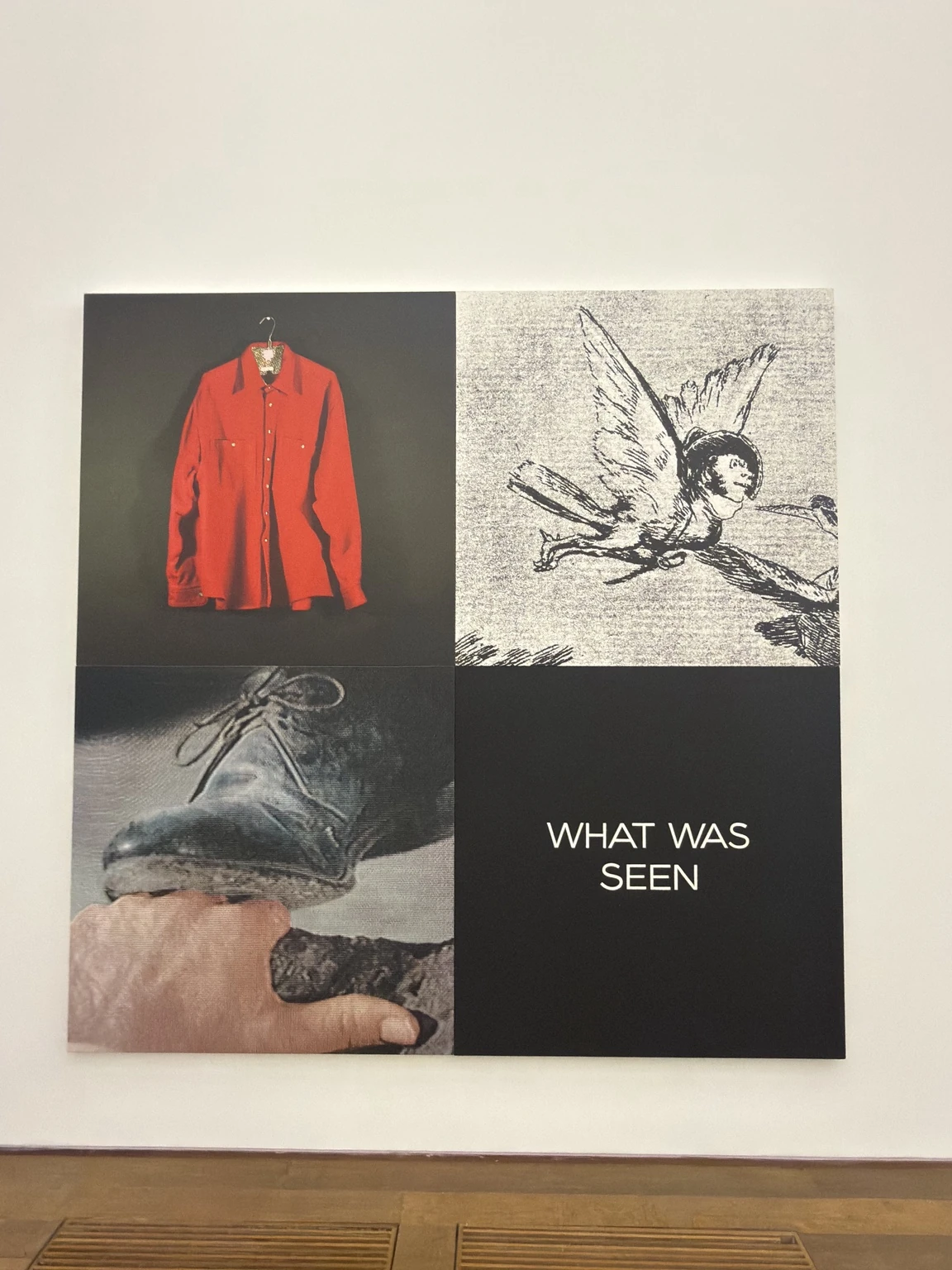
These questions began to connect with another work by Baldessari. Tetrad Series: What Was Seen brought together four parts: a red shirt, an image by Goya, a scene from a Hitchcock film, and the words “What Was Seen.”
And it was in this other work that I also came across Fernando Pessoa.
The words referred to a passage from The Book of Disquiet, quoted in the exhibition label:
“It weighs on me this sudden notion of the true nature of my individual being that did nothing but make somnolent journeys between what was felt and what was seen.”
Fernando Pessoa, The Book of Disquiet.
There is unease in that sentence. “It weighs on me” and “somnolent” make me think of someone suddenly realizing how much of life they had been living without examining themselves. That discomfort leads me to consider the distance between what happened and the meaning I gave it.
A brief reply, for example, can seem like a lack of interest when I feel insecure about a relationship. The other person may be busy, tired, or worried about something else. What I saw was a short reply. The meaning I gave it also depended on how I was feeling.
I can acknowledge that the reply bothered me and still need to understand what happened. The feeling is real, but it may not be enough to tell me what the other person meant. That distinction matters when I am about to act on my interpretation.
Baldessari's images do not give us a ready-made story either. Someone who recognizes the film may make one connection. Someone familiar with Goya may find another. Someone drawn in by Pessoa may begin with the words and then return to the images. We are looking at the same composition and noticing different things.
Experience helps a great deal, of course. But I also need to notice when I am using a previous experience to explain a new situation too quickly. Something can feel familiar and still have important differences.
This is where the reflection begins to reach my own decisions. My preference for an image may be enough for me to choose it. To assess a person, turn down a proposal, or take on a responsibility, I need to consider what supports my conclusion and what might happen if I am wrong.
The greater the consequences and the harder a choice is to reverse, the more care I believe it requires before acting. Trying an idea for a few days allows room to learn and adjust. Making a long-term commitment involving other people and significant resources calls for checking things first. I also need to consider the cost of waiting: an urgent decision requires choosing which uncertainties really need to be resolved within the time available.
This shift in interpretation becomes very concrete in Repository. Three ceramic pieces, in red, yellow, and blue, resemble small toilets. They are bedpans, objects with a sanitary function. On them is the phrase “The artist is a fountain.”
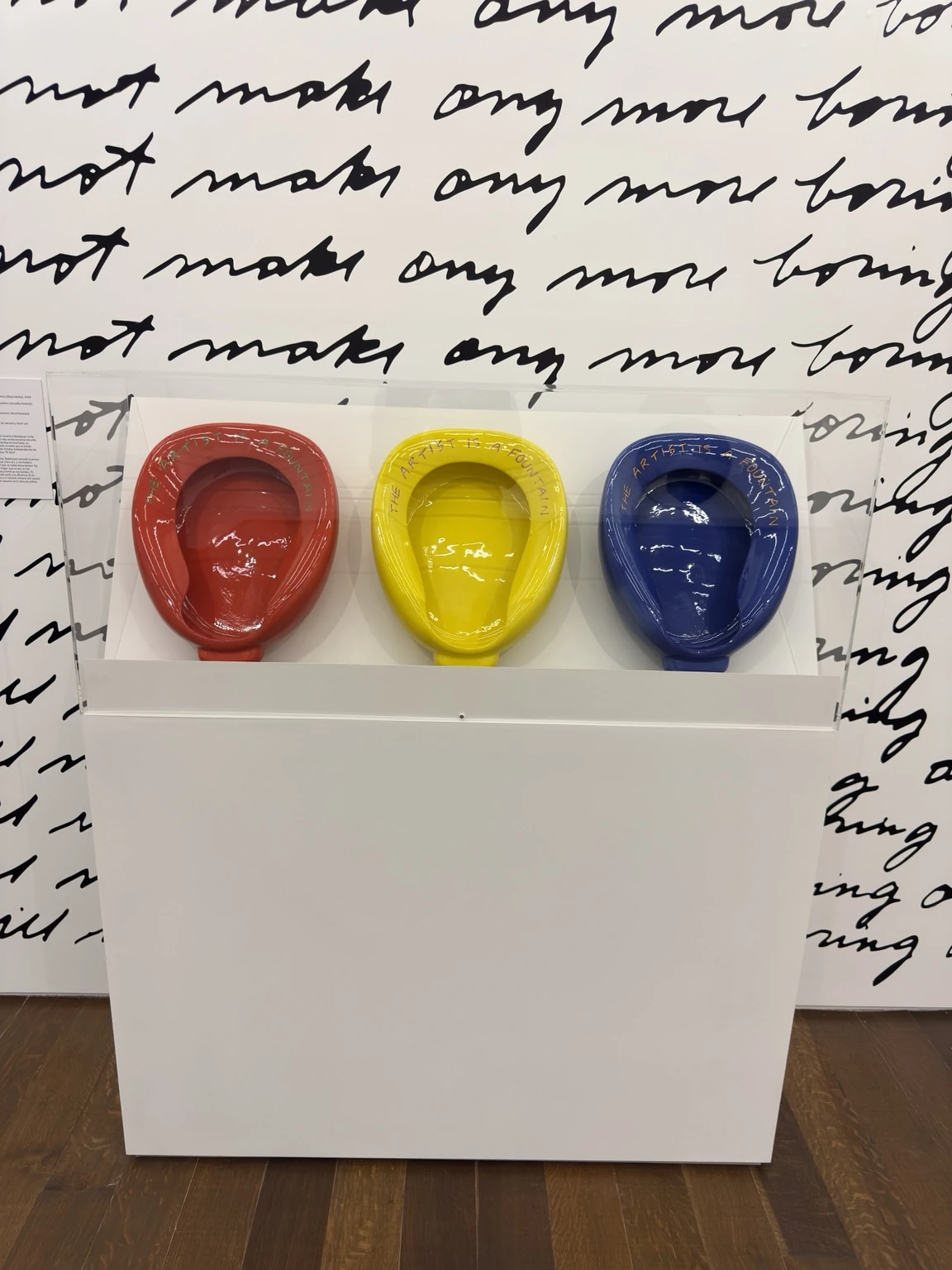
Baldessari returns to Fountain by Marcel Duchamp, who presented a urinal as a work of art. Knowing this reference allows me to see a connection that the objects' appearance alone does not explain. I also begin to consider the idea, the choice, and the context.
But that explanation can also steer my response. I may like the work more because I have understood something, or because I have begun to respond to the prestige of a name. Knowing the reference broadens my reading, but I still need to notice what has actually changed in my judgment.
This also happens when I ask someone for their opinion about a decision. They may contribute something I had not considered. They may also interpret the situation through their own preferences. And I may choose to listen to precisely the people who tend to agree with me. Gathering more opinions does not, by itself, guarantee a better understanding.
As I bring this reflection to a concrete decision, I arrive at four questions:
- What did I actually observe?
- What did I feel, and how did I interpret it?
- What can I check before acting?
- What information would make me change my mind?
In the case of the brief reply, I can ask whether it is a good time for us to talk. I can check whether it was an isolated incident or part of a recurring pattern. My initial interpretation becomes something I can examine before responding as though I already knew the other person's intention.
The last question also helps me notice my willingness to reconsider. If I look only for arguments supporting what I have already concluded, I may finish my research feeling more confident without having examined what might challenge my opinion.
I also need to know when to stop investigating. Information deserves time when it could change the decision or how I carry it out. If what is missing would not alter my next step, perhaps I can already act, acknowledging what remains uncertain and deciding under what circumstances I will reassess the choice.
That responsibility for my own interpretation is what I take from the visit. My first reaction may happen without my choosing it. I can still develop the care with which I examine it before deciding.
Thinking of a decision you need to make now, what assumption could you still check, and what answer would lead you to choose a different path?